
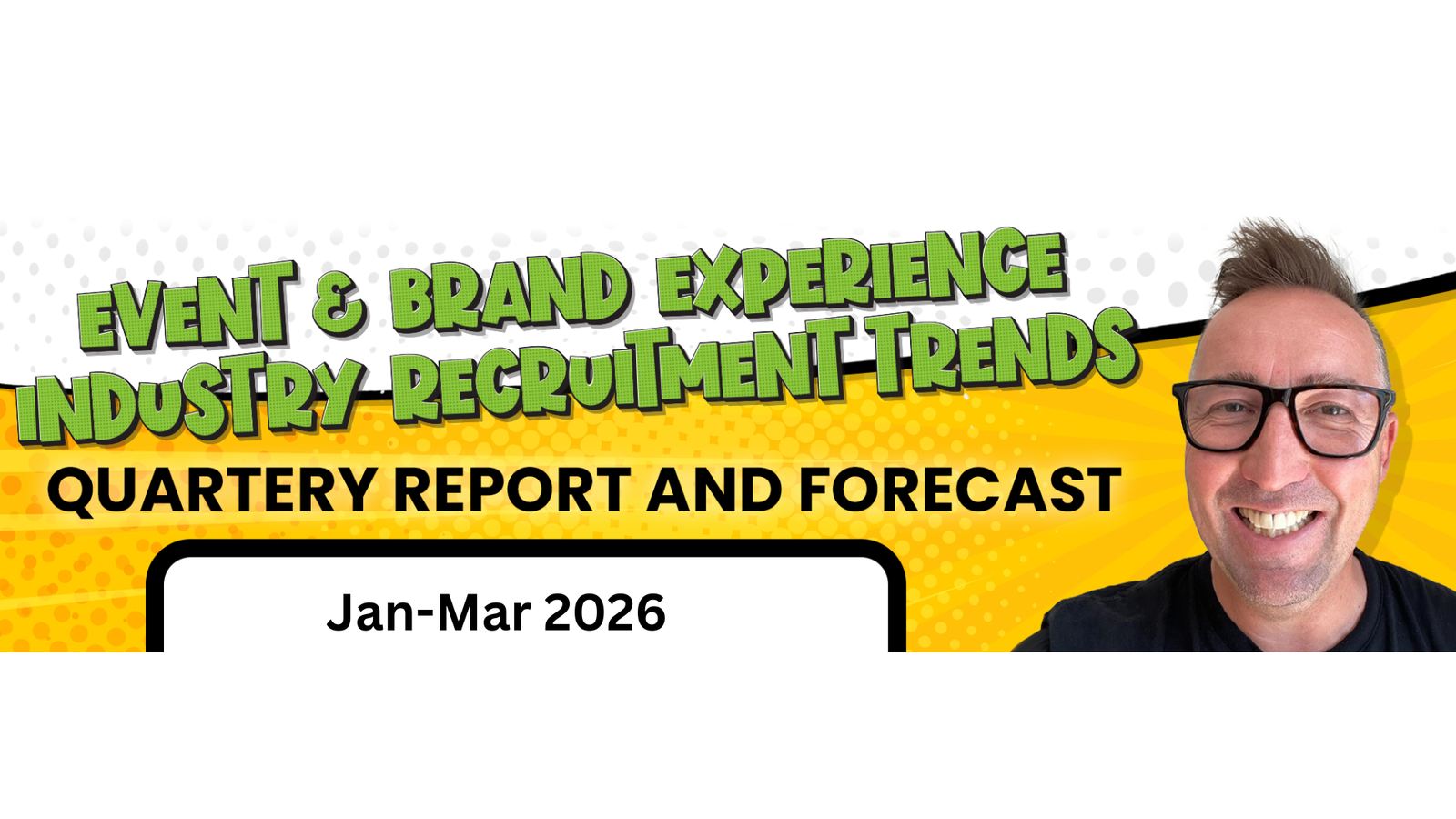
I spend my time speaking to owners, HR leaders and C-suite decision makers across events, experiential and MICE, so what follows isn’t theory. It’s what’s actually happening on the ground.
Q1 2026 has been shaped by the after-effects of last year’s mergers, a spike in resignations, the limits of DIY hiring, and continued demand for commercial talent.
Here’s what I’ve been seeing and what I think is coming next.
Trend 1: The M&A Confetti Has Settled. Now Come the Redundancies
Last year was full of mergers and acquisitions.
Now the celebrations are over, and the operational reality has kicked in.
Once the confetti is swept away, the hard work starts. You suddenly realise you’ve got three Managing Directors, two Client Services Directors, and overlapping teams. The easiest cost to cut is people.
As a result, Q1 has seen a noticeable wave of redundancies as businesses streamline duplicated roles and reduce overheads.
In the last ten years, I’ve never seen so many redundancies in one quarter. This isn’t about performance. It’s simply the structural reality of consolidation.
Trend 2: Culture Shock Is Driving a Wave of Resignations
Redundancies are only half the story.
The other side of post-acquisition life is people choosing to leave.
People who joined smaller, founder-led agencies often find the culture changes overnight when a larger network takes over. The job simply isn’t the same anymore. The autonomy disappears. Decisions go through multiple layers. Even things like flexibility or informal culture can shift quickly.
So people are voting with their feet.
I’ve seen more resignations this quarter than I expected, particularly at mid-to-senior level. For many, it’s not about the role. It’s about the environment no longer fitting.
Trend 3: DIY Recruitment Is Backfiring
Another clear pattern this quarter is businesses trying to handle hiring themselves and struggling.
LinkedIn quick-apply has made recruitment look deceptively easy. You post a role, press a button, and suddenly you’ve got 100 applications. But volume isn’t quality.
What I’m seeing is businesses overwhelmed with unsuitable CVs, or hiring too quickly based on familiarity rather than evidence.
Hiring a friend of a colleague or someone who “seems great” can work. But it’s a coin flip.
Proper recruitment processes exist for a reason.
I’m also having more conversations than ever that start with:
“We’ve been trying to hire this role for six months. Can you help?”
Trend 4: Sales and Client Services Roles Are Leading Demand
Sales and client services roles have been the most consistent hiring need, and the timing isn’t a coincidence.
Q4 bonuses get paid, then salespeople start looking around. At the same time, agencies enter new financial years with growth targets.
So you get a predictable cycle.
Businesses want to grow revenue, and experienced sales talent becomes available at exactly the same time.
There’s a real focus on both new business roles and strengthening client services. In many cases, it’s more efficient to grow existing relationships than constantly chase new logos.
Trend 5: Leaders Are Moving to Smaller, More Honest Conversations
Something else I’m seeing more quietly is how senior leaders are choosing to connect.
There’s a shift away from big industry events towards smaller, peer-to-peer environments.
Senior leaders want to sit in a room with people who have the same problems. Those conversations are far more valuable than walking a trade show floor.
Invite-only lunches, small forums, and peer groups are growing for a reason.
The tone is more collaborative than competitive. People are being more open and more honest, and that’s a good thing for the industry.
What I Expect to Happen Next
1) More Talent Returning from the Middle East
We’re already seeing the first wave of people returning from the Middle East, and I expect that to increase over the next six months.
Some went out during the boom years, but a number are now coming back, partly driven by regional instability.
That’s going to add more depth to the UK talent pool as we move through 2026.
2) Agencies Will Reduce Reliance on Single Large Clients
One of the biggest lessons I’m seeing is around client concentration risk.
Agencies used to feel safe if they worked across multiple brands within one big client.
But procurement can change that overnight.
The smarter businesses are now actively diversifying. They are spreading revenue across multiple clients rather than relying too heavily on one relationship.
3) The Market Is Healthier Than It Sounds
Despite what you might hear, a lot of agencies are actually doing okay.
The mood feels very British at the moment. People are performing well, sometimes even growing, but not shouting about it.
There’s less hype than a couple of years ago.
But underneath that, a lot of businesses are in a solid place.
4) Pharma and Healthcare Will Be a Standout Growth Area
Pharma and healthcare events are starting to evolve.
Traditionally more transactional, the sector is now looking at how to create more engaging, experience-led work without losing scientific integrity.
It’s not an easy space to enter. Regulation, compliance, and stakeholder complexity are all barriers.
But if you can navigate that, the opportunity is huge.
It’s a tough sector to break into, but once you’re in, it’s a very strong, long-term growth area.
In Short
Q1 2026 hasn’t been a decline. It’s been an adjustment.
We’re seeing the after-effects of consolidation, a reset in hiring behaviour, and continued demand for commercial talent.
The industry isn’t collapsing.
It’s evolving.
And the businesses that will do well are the ones adapting, diversifying, and planning ahead.
If you want more of this, real insight from what’s actually happening behind the scenes, I share it regularly in my Recruitment Report.